What is an MCP server and why your business should want one

Picture a customer opening ChatGPT and typing: "I want running shoes, size 42, under 2 000 CZK, delivered by Wednesday." The AI checks your stock, compares prices, confirms availability and places the order. The customer never opened a browser. Never visited your website. And yet they bought from you. An MCP server is exactly what makes this possible.
How does this actually work?
AI assistants like ChatGPT, Claude or Gemini are smart today, but without access to your data, they are blind. They do not know what you have in stock. They do not know your prices. They cannot place orders. They work like a very clever encyclopaedia, but not like a real assistant that acts.
MCP (Model Context Protocol) changes that. It is an open standard that lets AI assistants communicate directly with your systems: stock, pricing, orders, CRM. Suddenly the AI does not answer from a textbook, but from your live data. It does not just answer. It acts.
Why this is a turning point for businesses and e-shops
Today a customer searches on Google, lands on your website, browses the catalogue and (hopefully) buys. That model is changing. More and more people start their purchasing journey with an AI assistant. Those assistants are quickly learning not just to recommend, but to buy on their behalf.
A business with an MCP server exists in this world. A business without one does not. Simply because an AI agent has no way to reach it.
In practice this means:
- Customer asks ChatGPT about a product, the AI checks your stock via MCP and proposes a specific item with live price and availability
- Customer confirms and the AI creates the order in your system via MCP
- The entire purchase happens without the customer ever opening your website
The same applies beyond e-commerce: bookings, enquiries, service requests, B2B orders. Everything that today requires a form or a phone call can be handled directly by an AI agent.
Who is behind this and why it is credible
MCP was published by Anthropic in November 2024 as an open standard. Within months OpenAI, Google and Microsoft adopted it, essentially every major AI player. In December 2025 Anthropic transferred MCP to the Linux Foundation, the same path Linux and Kubernetes once took. It stopped being one company's product and became neutral industry infrastructure.
This is not one company's experiment. It is the foundational infrastructure for the next wave of AI agents.
Why invest now and not in a year
2025 was the year of adoption. Large companies and early adopters started building MCP servers. 2026 is the year of expansion and AI agents for shopping and ordering are entering the mainstream.
Businesses that deploy an MCP server earlier gain concrete advantages: they collect data from day one and improve their assistant every month, they build visibility in the AI world ahead of competitors, and in a year, when this is standard, they will be where others are only just starting.
In 12 months an MCP server will not be a competitive advantage. It will be a hygiene factor, like having a website or being on Google today. The difference is that whoever starts now has a year's head start.
Custom-built or off-the-shelf?
Off-the-shelf solutions exist, but they stay generic. Your shop or business has its own stack, its own data, its own rules. A custom MCP server wires into exactly what you use, whether that is Shoptet, WooCommerce, a bespoke ERP or a combination of tools.
The process is straightforward: we map your systems and data sources, design the MCP server architecture, connect it to your tools and test it with real AI agents. The result is a business that exists and sells in a world where AI shops for people.
Curious what an MCP server could look like for your business? Book a free 30-minute audit. We will walk through concrete options with no obligation.
Recommended articles
From August 2026 your AI voicebot must admit it is a robot. What it means for small businesses
Since 2 August 2026 the AI Act transparency rules apply. Both chatbots and phone voicebots must tell the customer they are not human. Here is what it means in practice and what to fix in one afternoon.
Read article
ChatGPT for business: a practical guide 2026
Most businesses tried ChatGPT and were disappointed. The problem is not the tool. It is how they use it. Here is how to do it right.
Read article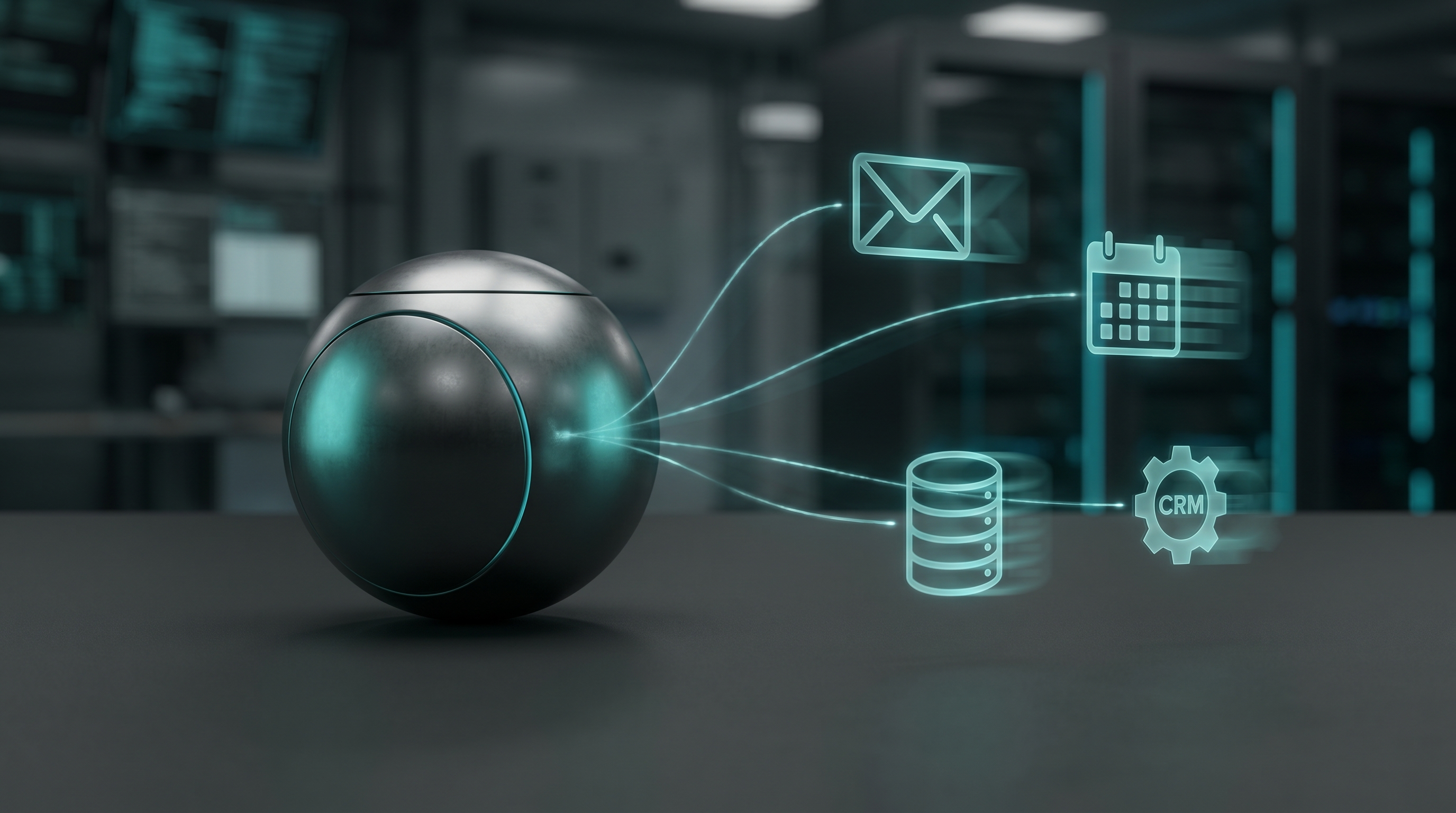
AI agents in business: what they will handle for teams in 2026
An AI agent is not just a chatbot. It can work with tools, data and tasks. For companies, that means a new layer of automation.
Read article